blending the mix

social media,paul fabretti

A look at the new world of marketing and PR

When the influencers become influenced

A funny thing happened to me the other day, no, honestly it did…and it really got me thinking about other ways that we might shape/influence groundswell about our clients and client’s products and services. It’s a bit of a brain dump and perhaps with more considered thought it may be an utter waste of your time, but if it makes you think a bit about how you do your job then it has served its purpose, even if you don’t agree!

So, the background…Mrs F has been fortunate enough to be trialling some Skechers Shape Ups thanks to Sylvie at fuelmyblog. They are the shoes (which look a little odd to be fair) which kind of get you fit whenever you wear them because of the way they make you change your posture. They are a little girly, but the geeky stuff as to how they work and why is fascinating and Mrs F loves ‘em.

Anyway, I have been so impressed with the shoes, quality etc. that I ended up buying not only a different pair of shoes for me, but also my son – rendering me £100-odd worse off. Admittedly, there’s a somewhat dubious association with my normal topics of writing (and for that I apologise for anybody who is sensitive to this), but it raises questions about how we might talk about influencing the connectors in a network rather than purely the influencers.

Would a marketer be happy that as a family we have been “Skechered” or would they prefer to have shifted 3 pairs of the specific new shoe they have launched.

If social media is about people, why doesn’t Outreach get more personal?

Outreach activity typically focuses on trying to engage a group of influential individuals to write positively about our clients – these people tend to express an opinion about a topic or product which is pertinent to them and their audience.

But if we are trying to get to know this person, understand the content they publish, why wouldn’t we also want to know more about them?

Neither I or Mrs F were in the market for the Shape Ups but as a result of the trial, we have spent over £100 on Skechers products.

The obvious weakness of this thinking is that it makes totally perfect sense only to send stories to publishers (of whatever size) that are relevant to them and their audience. Why should this approach change?

On the other hand though, that influential blogger still eats, wears clothes, drives a car etc., so why wouldn’t we consider (if we do really care enough about developing a lasting, fruitful relationship with that person) how we may also extend “off-topic” products to that blogger. If we are keen to develop a good relationship with them, then surely we would be able to tell them that we simply appreciate their feedback in whatever format it comes.


Businesses still taking days to respond to website enquiries

I hope Ian and the team at Internet Retailing won’t mind me taking his headline because it pretty much sums up a dire situation.

To save you the best bits:

  • 25% of websites failed to respond to a customer enquiry via their website
  • When prompted 14% of the same businesses STILL didn’t respond

I remember a while ago presenting to the board of a well-known hotel chain and extolling the virtues of the social media approach that Marriot Hotels had in place with their blog (pictured below)

 marriot

It’s a great blog, written by Bill Marriott himself (and I suspect a few editors too!) but gives a great insight into the history of the business and the personal approach that sets a good hotel apart from a bad one. The content is genuinely interesting (even if there is a sales-y angle to some of the content) and frequently commented upon. At the same time, the blog editors also respond pretty quickly too.

But, when you look at the contact us page on the main Marriott website(below), we see the standard “disappear into the online ether” contact form that is mentioned in the critical report posted at the top.

contact form marriott

Is anyone else looking and wondering how a business who, on one hand with the blog, seems to be at the forefront of customer relations and service, manages to so dreadfully miss the boat when it comes to the ways its clients can contact it?

Still, at least they have made better progress than most, it’s just a shame that all their points of contact can’t be as responsive as others.

Technorati Tags: marriott,blogs,customer service


The Cluetrain Manifesto – in Slide Format

As we all (should know) The Cluetrain Manifesto is one of the most important pieces of writing to explain why this whole social media circus/bandwagon/phenomenon is so important.

Some people have never heard of it, some are only just discovering but if I could recommend one book – this would be it (although David’s is a pretty good, as is Brian and Geoff’s…).

But, whilst it has been available for free since 1999, and in available in print in all the usual places, it’s 95 theses were always a bit of a bugger to read until now…so, thanks to the tecorporation and SODB, we have the 95 Cluetrain Theses in easily consumable Slideshare format.

Enjoy.

Learn.

Implement.

Technorati Tags: cluetrain manifesto


The 14 most essential tools for a killer Twitter strategy

So, as you will have seen from my previous post, I spoke at the Figaro Digital Social Media event on Tuesday 28th July about how using a few cool and insightful tools can help you make the most of your existing Twitter strategy (especially if you were a brand).

The presentation seemed to go down pretty well but I know that the best bits are the tools that make finding, understanding and developing your  twitter presence that bit more effective. And, Steve reckons I know what I’m on about so I guess I have something to live up to there!

Do you really need a whole load of tools?

Many people have argued that to be so analytical (anal even!!) about Twitter is to some extent, defeating the object. “Get in there and just talk to people” is not an unreasonable approach…but then again, is that what @habitatuk thought when they let an intern loose on their account?

Relevancy and context are core aspects of brands being relevant in social networks, but only when we know to whom we need to be relevant, can we be so – which is why many of the tools we use (and are listed below) are about understanding the people behind the tweets.

Below is a little bit of commentary as to why we use some of the tools we do. If you have any more, do let me know, i’m always keen to learn!

Relevancy

When we are launching a client’s Twitter account, it is important that we make the best use of that client’s time and engage initially with only those people who we know to be talking about that client, their competitors, products or industry. I call this the Push phase of the approach – where we are trying to FIND friends to talk to.

If we approach this wisely, we end up with friends who we know to be very relevant to our client’s business in that they already share an interest or have tweeted on something that would be of interest to us. This gives us (even without mentioning anything about our product or brand) a valid reason to talk to that person.

Re-tweetability

This phase is perhaps a little too mercenary for many, but again, when it is not our money we are spending, something which anyone should pay more attention to if they are trying to get more out of less!

Someone tweeting something relevant is one thing, but someone re-tweeting who re-tweets is quite something else. In an ideal world, a superstar follower will re-tweet everything we tweet, but we know this is not the case.

With Dan suggesting that re-tweets are on average, only 2-networks deep (i.e. a re-tweet only gets seen by two friends’ networks), we need to make sure that we have plenty of followers who are more likely than not to re-tweet some of our content. Some of the tools we use helps us understand the likelihood of that person passing on our content.

It’s contrary to the notion of degree centrality – that the person at the heart of the network is the most influential, when what we actually want are the people who can connect us to a wider audience with the least amount of steps (Markov centrality). Mercenary yes, but necessary.

Management

When we move beyond the Push stage – of finding followers who are relevant re-tweeters, and we are conversing in a friendly, respectable and relevant manner (which might include twitpic, competitions, offers etc.), we will begin to naturally attract followers. The question then is raised of how we manage these people and how we remain mindful of what makes that person tick, what their experience has been of us (are they a customer, complainant, troll etc.) and who is going to manage that relationship.

Tools like Topify, otherinbox and Co-comment all help to assign notes, people and tweets to ensuring that the valued relationship we created is not lost with one careless tweet.

So, not rocket science admittedly, and some of the tools below will add more features to your toolkit (and not all of them perhaps relevant or of interest to you), but I do hope you will find them useful and please let me know of your own experiences.

Step 5: Branded backgrounds – Twitter Backgrounds

Step 6: Twitter Search

Step 7: Topic trends – Twist/Twitscoop

Step 8: Multiple topic monitoring – Tweetgrid

Step 9: Email topic alerts – Tweetbeep

Step 10: Tweet frequency, trending topics and influencers – Twazzup

Step 11: Follower audience profile – Twittersheep

Step 12: Follower profiling and engagement patterns – Twitter friends

Step 13: When is it best to approach them – Tweetstats

Step 14: Making images more viral – Twitpic/Yfrog

Step 15: Multiple account management – Otherinbox

Step 16: Easy follower management – Topify

Step 17: URL shorteners with analytics – bit.ly

Step 18: Account management/allocation – Co-Comment/Tweetdeck

Technorati Tags: twitter,tactics,strategy,help


How to get the most out of your Twitter strategy

So I spoke at the Figaro Digital “Social Media” event on Tuesday. I really struggled to think of anything useful to talk about (some might say I didn’t even achieve that!), after all, how many times will people regurgitate the same old case studies and say the same old things “the customer is in control” blah, blah, blah…

Instead, I left the insightful stuff to my new buddy, all-round good guy and smart-cookie Freddie (and just had to agree with everything he said!) and thought I’d do something practical, that didn’t preach and simply highlighted some just some really useful really.

As it turned out, 90% of the audience was already using Twitter in a personal capacity and almost 50% in a professional one – who needed me to tell them how or why to Tweet?!

So, the presentation is below for you all to see. As always, i’d love to hear your thoughts and ideas, recommendations, criticisms (be fair though!!)

Technorati Tags: twitter,how to,business,strategy


What the F*CK is Social Media? One Year On

Marta follows up her amazing potty-mouthed social media presentation with an update. I don’t honestly think a lot has changed in terms of what tools we are using, but there is a definite mood of – it’s here, just f*cking do it now, you have no excuses (in Marta’s words anyway!)

And if you missed the first one…

And in case you had ANY doubt as to whether Marta is the real deal, the above presentation has been seen a total of over 131,000 times and embedded over a 1000 times. The kinds of figures any one producing a video would be proud of - and this is a presentation on social media for f*cks sake!

Technorati Tags: social media,what the f*ck is social media,marta kargan,presentation


Possibly the best Facebook friend mapping tool to date

I seem to be a on a roll with the Facebook stuff at the moment, but this little gem from Nexus would get even Rodney and Nick excited (if they aren’t already!)

The Social Graph – a quick refresher

We have talked for some time about the “social graph” - this sometimes mythical explanation of an individual’s profile in a social network. The cynics amongst you may consider it Social CRM – and if we weren’t now approaching customers as people rather than numbers (as we used to!), you’d probably not be far wrong.

Facebook has always been an exciting tool to help us understand this social graph (you might argue that the structure of Facebook means that the phrase derived from Facebook). Applications are/were one of the best ways to understand the complexity, strength, depth and reach of an individual’s presence in Facebook.

When someone adds an application in Facebook, we are privy to a whole host of information about that person and their network that is in the words of the olden-days “gold dust”.

What this access does is helps us understand the person behind the profile. As the video below shows (the bomb gets dropped at 1m 35s to be precise!), customers are no longer a set of general demographics.


But if the social graph helps us understand WHO the customer is rather than WHAT they are – and approach them appropriately - one thing we are still struggling with (and pals Tim and Matt are making a good stab at doing), is understanding within these social graphs, just WHO are the influencers. Who SHOULD we be talking to?

Network Influence

I’ve been working with Influencer Mapping for over 3 years, and whilst I will be the first to admit I don’t really understand how it works, I know what to do with the information when I get it. Sometimes though, this can be timely and expensive and even unreliable. I think Tim and Matt would be the first to admit that DIY influencer mapping is tricky at best.

Tying all this up with Facebook though is a bit trickier. As a closed network, we have never really been able to understand who the most influential people (not the most popular) are in any given network - until Nexus launched the tool which created the map below:

friend map

So, it’s a “standard” network distribution map, but this has come from Facebook – one of the first to be exportable. You have to add the application (as you did with Touchgraph some time ago!) but you can then play with the results to your heart’s content here – outside of Facebook.

Nice, but not really THAT clever Paul…

And in a way, you are right – what good is this to anyone?

What if you had a Facebook Page for your brand or client though…what if you could add the Nexus graphing application to your Page…what if you could then map out and cluster the people who were fans of your Page…and you could also identify the people with the most common connections…or those who had the most in common…suddenly you are able to look at your audience in an entirely different way…and put more of your focus on developing relationships with the people who have the potential to be big advocates…rather than those who may simply be in it for the freebie you were giving away…

Assuming that the graphing tool can be ported over to Facebook Pages, we could have ourselves a very useful new planning tool.

Technorati Tags: nexus,social network analysis,facebook,networks,influencers


What services do people most use to share content?

Even since sharing badges (see the image below) made their way into web pages 18 months or so ago, nobody really has any idea of what bookmarking services they should add to their content to give their content the greatest reach.

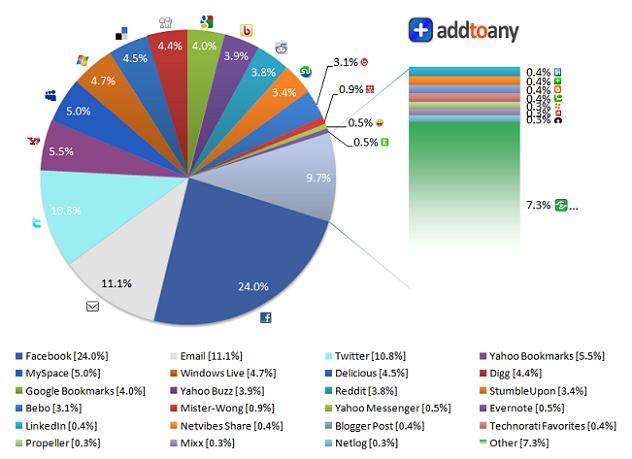
We all talk about syndication and dissemination of content but without really knowing where the best places are for our content to go – or, more importantly, the tools that most people use to circulate out content. No more.

Add to any, the people behind one of the most successful (and easy to implement) bookmarking buttons have released the chart below, detailing just what services most people post to.

I think there is a pinch of salt required with this because I suspect the data is Addtoany’s alone, but it makes for interesting reading. If, despite my post yesterday about Facebook’s audience numbers, you thought Facebook was a pointless place to target any marketing activity, perhaps this chart will make you think again – and do so in a way which means any message you do put out are relevant, timely and appropriate.

There’s a simpler version of the same graph here (with a lot of the lesser-known sites./sources taken out)


Technorati Tags: addtoany,bookmaring,sharing,facebook


The definitive UK Facebook audience breakdown

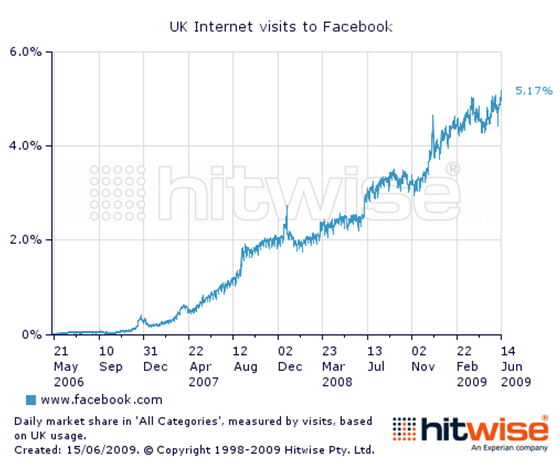
Robin’s chart below had some interesting stats about a huge surge in Facebook traffic last month when Facebook launched the vanity URL’s. Traffic to the site was up 9.5% on the previous Sunday.

So, in an attempt to place a line in the sand for many of you out there (clients and friends) who ask me how many people make up this huge social network, I spent a bit of time in the facebook ad centre splitting the UK Facebook population by gender and age – so haters, blame the peculiarities of people not putting gender or their ages correctly if some of the numbers don’t stack up!

Hope you find it interesting:

Total UK Facebook Audience:

Total UK numbers on Facebook (13+): 18,893,560

Total UK numbers on Facebook (18+): 16,422,540

Gender

Of the “more widely marketable” 18+ audience

Male: 8,471,880

Female: 9,734,640

Relationship Status

Single: 4,193,620

In a relationship: 3,818,520

Married: 3,345,920

Engaged: 873,080

City networks

Of the main UK cities, which has the largest network and what is their gender split?

London: 4,162,800

  • Male: 1,958,660
  • Female: 2,082,620

Manchester: 3,602,380

    • M: 1,618,260
    • F: 1,906,540

Leeds: 3,289,940

  • M: 1,490,960
  • F: 1,715,320

Birmingham: 1,706,180

  • M: 767,140
  • F: 869,060

Newcastle: 339,040

  • M: 156,500
  • F: 167,360

Note that this won’t represent the overall numbers of people from these cities, merely those who have assigned themselves to a network and who live within Facebook’s default 50mile city radius setting.

Total UK audience by age and gender

Age 18-24: 5,287,780

  • Male: 2,426,840
  • Female: 2,670,340

Age 25-30: 3,622,960

  • Male:1,744,480
  • Female: 1,862,540

Age 31-35: 2,153,020

  • Male: 978,240
  • Female: 1,058,520

Age 36-40: 1,835,400

  • Male: 820,160
  • Female: 907,480

Age 41-45: 1,306,700

  • Male: 560,720
  • Female: 666,420

Age 46-50: 886,240

  • Male: 371,900
  • Female: 449,680

Age 51-55: 566,000

  • Male: 231,560
  • Female: 302,240

Age 56-60: 381,580

  • Male: 157,780
  • Female: 200,540

Age 61-64: 210,120

  • Male: 85,960
  • Female:  105,120

So, there you have it – hope it helps you to make some useful decisions!

Technorati Tags: facebook,uk audience,demographics


How the Top 100 Brands are using Social Media

Charlene Li comes up trumps again with this fascinating rating of the Top 100 brand using social media.


Technorati Tags: altimeter,charlene li,ranking the top 100 global brands